Language Barriers in Healthcare: The Data, the Risk, and What Clinicians Can Do
Tens of millions of people in the U.S. have limited English proficiency, and most speak Spanish at home. Communication failures are a recognized patient-safety issue. Here is what is well established, what clinicians are legally required to provide, and what individual providers can realistically do at the bedside.
Tens of millions of people in the United States speak English less than "very well," and the majority speak Spanish at home. For a patient with limited English proficiency (LEP), a routine clinic visit or emergency-department encounter carries an added layer of risk that the surrounding care team does not always see.
This guide summarizes what is well established about language barriers and patient care, what U.S. law and CLAS standards require of clinicians and health systems, and what individual providers can do — with or without a professional interpreter in the room.
What the outcomes data shows
Language access has been recognized as a patient-safety issue by AHRQ and The Joint Commission, and by a substantial body of peer-reviewed literature. A few findings are consistent enough to plan around:
- Adverse events involving LEP patients are more likely than those involving English-proficient patients to be linked to communication failures (Divi et al., 2007, and subsequent work).
- Informed consent obtained through ad-hoc interpretation — a family member, a bilingual staffer without training — is measurably less complete than consent obtained through a qualified professional interpreter.
- Patient-reported satisfaction and understanding of the care plan are lower when the visit is not conducted in the patient's preferred language or through a qualified interpreter.
- Effects on length of stay, readmissions, and adherence are documented in individual studies but are more variable across settings, so any single number in that space should be read with caution.
Why "we have a phone interpreter" is not the whole answer
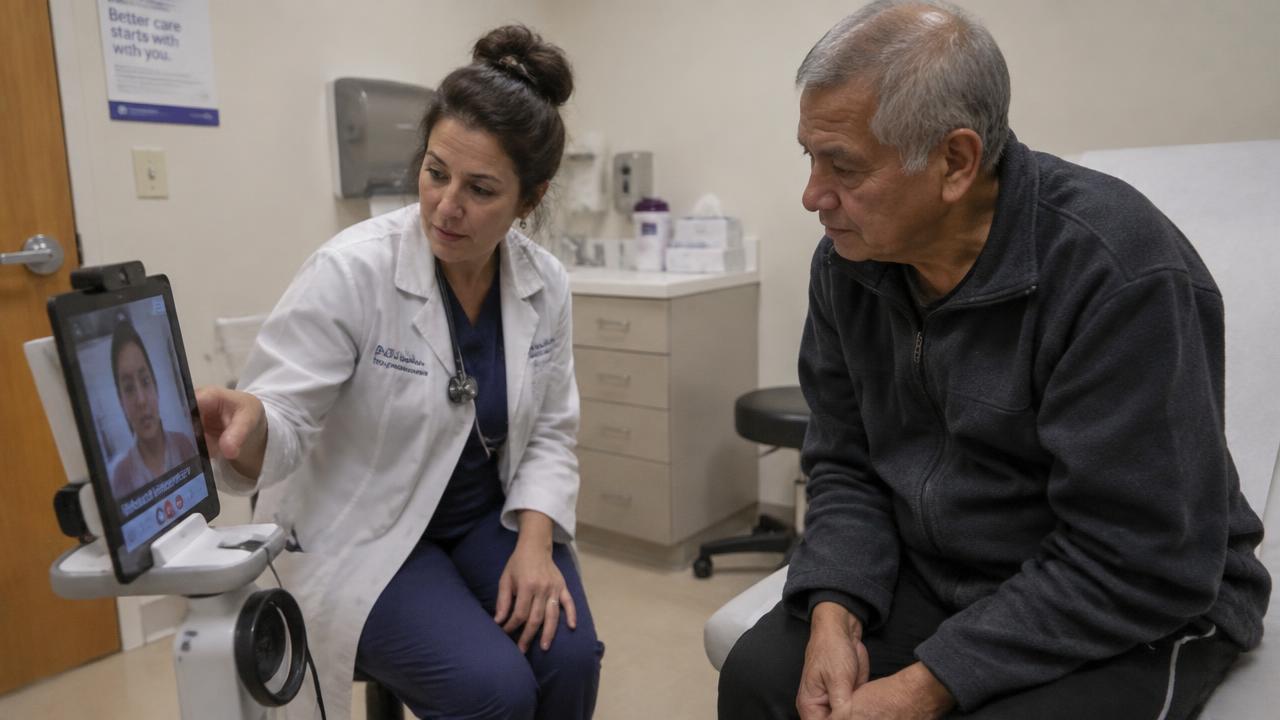
Professional interpreters — in-person, video, or telephone — are the legal and clinical standard, and they should always be offered. But interpreter use in practice is uneven: audits repeatedly find that clinicians underuse interpreters for "quick" interactions (a med reconciliation, a bedside status check, a discharge clarification), precisely the moments where miscommunication compounds.
The clinicians who close the gap tend to do two things at once: they use professional interpreters for anything consequential — history, consent, discharge — and they build enough of their own Spanish to handle greetings, rapport, and simple check-ins directly. That combination is what changes the patient experience, not either piece alone.
The legal and accreditation backdrop
Two frameworks matter for U.S. clinicians:
- Title VI of the Civil Rights Act requires any provider receiving federal funds (which is nearly all of them) to offer meaningful language access to LEP patients — at no cost to the patient.
- The National CLAS Standards (Culturally and Linguistically Appropriate Services), maintained by the HHS Office of Minority Health, set the operational bar: qualified interpreters, translated materials, and staff trained in culturally responsive care.
- The Joint Commission incorporates language access into its patient-centered communication standards for accredited hospitals.
What individual clinicians can do
Systemic change is slow. Individual practice change is not. A short list of what actually moves the needle:
- Default to a professional interpreter for history, consent, and discharge — every time, not just when it feels "complicated."
- Learn the 40–50 highest-frequency clinical phrases in Spanish for greetings, rapport, and simple check-ins. This alone changes the temperature of the visit.
- Confirm understanding with teach-back through the interpreter, not by asking "do you understand?" — LEP patients disproportionately answer yes even when they do not.
- Document the patient's preferred language in the chart and use it consistently across visits so the next clinician does not restart from zero.
- Learn to pronounce the patient's name and one or two culturally specific greetings. Small signal, large effect on trust.
Where Medical Spanish fits
Medical Spanish is not a replacement for a professional interpreter, and no reputable course claims it should be. Anything consequential — history, physical exam findings, consent, diagnosis, discharge instructions, medication changes — belongs with a qualified interpreter, in person, by video, or by phone. What structured Medical Spanish adds is the layer around those exchanges: a warm greeting when you walk into the room, the patient's name pronounced correctly, a reassuring word during a procedure, orienting a patient to what will happen next. Those moments shape trust, and they are not what interpreters are usually called for.
For clinicians who want structured, accredited practice, our AAFP-Prescribed Medical Spanish program is built around exactly this use case: high-frequency clinical vocabulary, patient-centered dialogues, and pronunciation feedback — earning CME credit while you build a skill you will use with patients tomorrow.
Preparing for bilingual clinical roles
Some clinicians go further and pursue formal language assessment to serve as qualified bilingual staff or to meet hospital language-competency requirements. ALTA-style exams are one common path: they test whether a provider can communicate safely and effectively with Spanish-speaking patients in a clinical setting.
If you are preparing for that kind of assessment, our sister site https://medicalspanishtestprep.com offers targeted practice and study materials built around the medical Spanish and interpreter-ethics knowledge those exams expect. It is a separate step from CME — more focused, more test-driven — and it pairs well with the foundational skills built here.
Further reading
- HHS Office of Minority Health — National CLAS Standards (thinkculturalhealth.hhs.gov).
- AHRQ — Improving Patient Safety Systems for Patients with Limited English Proficiency.
- The Joint Commission — Advancing Effective Communication, Cultural Competence, and Patient- and Family-Centered Care.
Bottom line
Language barriers in healthcare are one of the clearest, most measurable drivers of inequitable outcomes in the U.S. — and one of the most actionable at the individual clinician level. Use interpreters properly, build your own working Spanish for the moments interpreters do not cover, and the visit changes for the patient in ways the data now supports.
Earn CME credits while you learn
Our AAFP-accredited online medical Spanish course awards 38.25 CME credits across 51 modules. Earn 0.75 credits per module, on your schedule.
Get a free Medical Spanish word and phrase each week
One short email. Clinical vocabulary you can use the same day. Unsubscribe any time.